
Table of Contents
Have you ever looked at a breathtaking sunset over the Twelve Apostles or a candid moment at a family barbeque and wished you could capture it exactly as your eyes see it?
Photography is more than just pressing a button; it is a language of light, timing, and storytelling. In Australia, the creative arts are a vital part of our cultural fabric. According to the Australian Bureau of Statistics (ABS), approximately 23% of Australians participated in photography as a creative activity in recent years, making it one of the most popular hobbies across the nation. You can explore the full breakdown of these cultural participation stats on the official ABS website.
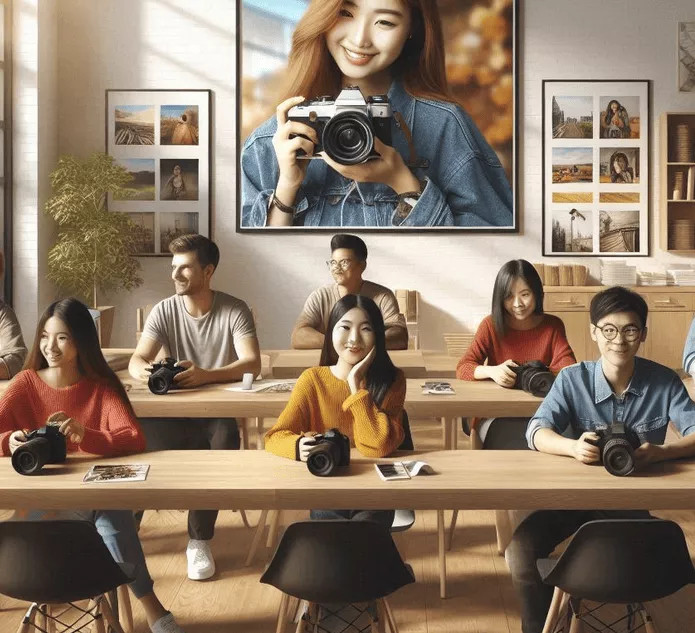
Whether you are holding a high-end DSLR or just using your smartphone, the journey from taking “snaps” to creating “art” starts with a solid foundation. Enrolling in a photography course for beginners is the most effective way to cut through the jargon and start seeing the world through a creative lens.
Why Choose a Photography Course for Beginners?
- Mastering Your Gear: Most people only use about 10% of their camera’s actual capabilities. A structured photography course for beginners helps you move away from “Auto” mode so you can finally understand what all those buttons and dials actually do.
- The Exposure Triangle: You will learn the relationship between Aperture, Shutter Speed, and ISO. These three elements work together to control how much light reaches your sensor and how motion or depth is portrayed in your image.
- Compositional Techniques: Taking a “good” photo isn’t accidental. Beginners learn the “Rule of Thirds,” leading lines, and framing—tools that guide a viewer’s eye exactly where you want it to go.
- Lighting Secrets: In Australia, we are blessed with incredible natural light, but it can be harsh. A photography course for beginners teaches you how to use the “Golden Hour” and how to manage shadows during the bright midday sun.
- Finding Your Style: Whether you are drawn to the rugged coastlines of Western Australia or the bustling street life of Melbourne, a course provides the space to experiment with different genres like landscape, portraiture, or macro photography.
10 Essential Steps to Kickstart Your Journey
- Understand Your Camera Body and Lens: Before you can take great photos, you need to know your tools. Learn how to hold your camera properly to minimise “camera shake” and understand the difference between a wide-angle lens (great for landscapes) and a telephoto lens (perfect for wildlife).
- Master the Exposure Triangle ($f$-stops, seconds, and ISO):
- Aperture ($f$-stop): Controls the depth of field. A low $f$-number like $f/2.8$ creates a blurry background, while $f/11$ keeps everything sharp.
- Shutter Speed: Measured in fractions of a second (e.g., $1/500$). Fast speeds freeze action; slow speeds create beautiful motion blur in waterfalls.
- ISO: Your sensor’s sensitivity to light. Use a low ISO (100–400) for bright days and a higher ISO for low-light situations, though be mindful of “noise” or grain.
- Learn the Rule of Thirds: Imagine your frame is divided into a $3 \times 3$ grid. By placing your subject along these lines or at the intersections, you create a more balanced and engaging image than simply centering everything.
- Focus on the Eyes: If you are taking portraits, the most critical rule in any photography course for beginners is to ensure the eyes are pin-sharp. The eyes are the “windows to the soul” and the natural focal point for any viewer.
- Use Leading Lines: Use natural or man-made lines—like a pier stretching into the ocean, a winding road, or even shadows—to lead the viewer’s eye toward your main subject.
- Chase the Golden Hour: This is the hour just after sunrise and just before sunset. The light is soft, warm, and highly flattering, reducing the harsh highlights often found in Australian landscapes.
- Check Your Background: Before clicking the shutter, scan the edges of your frame. Is there a stray wheelie bin or a tree branch “growing” out of your subject’s head? Moving just a few centimetres to the left or right can save a photo.
- Get Down to Their Level: When photographing children or pets, don’t shoot from a standing position. Squat down to their eye level to create a more intimate and personal connection in the image.
- Practice File Management: Part of being a photographer is organising your work. Learn to back up your files immediately and use basic editing software to crop or adjust the brightness of your shots.
- Join a Community: Learning is always better with peers. A photography course for beginners often introduces you to a local community where you can share tips, go on “photo walks,” and get constructive feedback on your work.
Watch: Photography Basics in 10 Minutes
For a visual breakdown of some of these concepts, check out this helpful guide for new shooters:
Photography Basics for Beginners
Taking the Next Step in Your Creative Career
While many Australians pick up a camera as a hobby, the professional industry is also thriving. The Australia Photography Services Market is projected to grow steadily through 2033, driven by a high demand for visual content in digital marketing and social media. If you find yourself falling in love with the craft, a photography course for beginners could be the first step toward a rewarding freelance career or a specialised niche like wedding or real estate photography.
Remember, every professional photographer started exactly where you are now—wondering why their photos looked “flat” or blurry. The difference is simply practice and the willingness to learn the “why” behind the settings. By investing time in a photography course for beginners, you are giving yourself the gift of a lifelong skill that allows you to freeze time and preserve memories forever.
Don’t let your expensive camera sit on the shelf gathering dust. Whether you want to capture the rugged beauty of the Outback or the simple joy in a friend’s smile, there has never been a better time to start.
Are you ready to stop taking snapshots and start creating photographs that tell a real story?
Would you like me to help you find a local photography group in your specific Australian city to help you practice these new skills?

I'm Arjun, a Bali-based wedding organizer with over 5 years of experience in beach parties, live music, bridal makeup and catering. I share practical destination-wedding guides from real events. I have published 2,425 wedding guides here since 2022.
More Stories
Buying a Drone Online: 5 Mistakes Wedding Pros Avoid
Professional Drone With Camera: 7 Buying Tips That Matter
5 Essential Drone Tool Features for Weddings