
Table of Contents
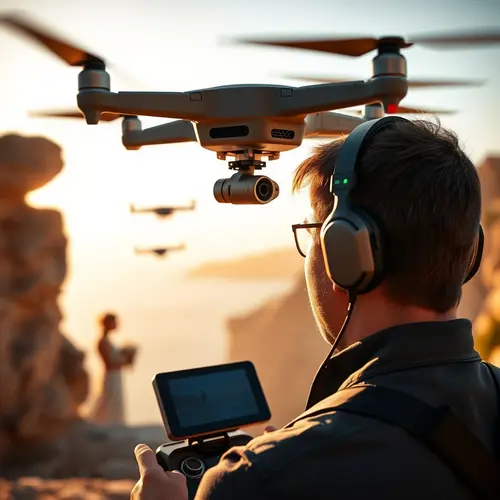
What do drone videographers actually do, and why do their services command premium rates? At its core, this specialty involves far more than flying a camera. It’s the art of capturing perspective-impossible footage that tells a compelling visual story, whether for a wedding, a real estate listing, or a cinematic production. The value lies in translating a client’s vision into breathtaking, stabilized aerial imagery that ground-based cameras simply cannot achieve.
Drone Videographer : The Professional’s Toolkit
Transitioning from recreational flying to professional videography requires a deliberate investment in both equipment and mindset. The FAA’s Part 107 certification is the non-negotiable legal foundation in the United States, establishing you as a pilot with knowledge of airspace, regulations, and safety protocols. This credential is your first mark of professionalism.
Your gear selection then defines your capability ceiling. While consumer drones offer impressive entry points, professional drone videographers often build systems around platforms known for robust transmission, high-bitrate codecs, and adaptable camera payloads. The choice between a ready-to-fly system and a modular rig depends heavily on the project’s demands for lens options, dynamic range, and slow-motion capture.
Decoding the Camera Spec Sheet: What Drone Videographer
Clients hear “4K” and assume top quality, but seasoned operators look deeper. Sensor size dramatically impacts low-light performance and depth of field. A one-inch sensor captures more light and detail than a 1/2.3″ sensor. Codec and bitrate are critical; a 100 Mbps H.265 codec preserves more image data during complex movement than a highly compressed format, giving you greater flexibility in color grading later.
Log profiles, like D-Log or Cinelike, are essential tools. They capture a flat, desaturated image that retains tremendous highlight and shadow detail. This “digital negative” requires color grading in post-production but unlocks a cinematic, dynamic range that auto-mode footage can never match. It’s a workflow commitment that separates amateur footage from professional film.
| Primary Use Case | Key Feature Priority | Typical Sensor Size | Post-Production Workflow |
|---|---|---|---|
| Wedding & Event Coverage | Portability, Quick Deployment, Reliable Tracking | 1-inch | Moderate; Color grading for consistency with ground shots. |
| Real Estate & Architecture | High Resolution, Slow & Precise Movement, HDR Capability | Micro Four Thirds / 1-inch | Focused on stabilization and perspective correction. |
| Cinematic / Commercial Production | Raw Video Output, Interchangeable Lenses, High Bitrate | Super 35 / Full Frame | Heavy; Includes LOG processing, VFX integration. |
The Five Foundational Aerial Shots Drone Videographer
Mastering a repertoire of deliberate shot types is what makes footage feel intentional, not random. These five form the backbone of professional aerial storytelling.
- The Reveal: Begin close on a subject, then ascend or reverse to unveil the expansive context. Perfect for establishing a wedding venue or a property’s location.
- The Orbit: Circle a point of interest while keeping it centered. This 360-degree perspective adds dramatic, cinematic weight to a structure or a key moment.
- The Dronie: The subject starts in frame, and the drone flies backward and upward, placing them in a growing landscape. It’s an emotional, closing-shot staple.
- The Tracking Shot: Follow a moving subject—a car, a boat, a couple walking—maintaining a consistent parallel path. This requires practiced piloting for smooth motion.
- The Top-Down (Nadir): Flying directly above the subject, looking straight down. This abstract, pattern-focused shot is powerful for showcasing landscapes, rooftops, or event layouts.
Drone Videographer – Navigating the Legal and Ethical Airspace
A professional’s responsibility extends beyond the monitor. The FAA’s guidelines, detailed in advisory circulars and the Part 107 rules, govern altitude limits (typically 400 feet above ground level), operations near airports, and flying over people. However, local ordinances in many municipalities add another layer, sometimes restricting take-off/landing from public parks or requiring specific permits.
Privacy forms the ethical cornerstone. A drone videographer must develop a standard practice of securing location permits and, when possible, notifying adjacent property owners during shoots in populated areas. The goal is to be invisible in your process but stunning in your result, avoiding any community friction that could jeopardize future work.
Drone Videographer : Debunking the “More Dynamic Range” Myth
A common pursuit is “more dynamic range,” but the expert focus should be on preserving the dynamic range the sensor already captures. The real failure point isn’t the sensor; it’s the pilot’s exposure setting. Blown-out highlights in a sky are unrecoverable data. The practice of “exposing to the right” (ETTR)—setting exposure so the histogram is biased toward brightness without clipping—alongside using ND filters to maintain a cinematic shutter speed, does more for image quality than chasing specs. As highlighted in cinematography whitepapers from the American Society of Cinematographers, controlled exposure is a fundamental discipline that outweighs hardware advantages.
Building a sustainable business requires moving past gig work. This means creating packaged service tiers (e.g., “Essential,” “Premium,” “Platinum”) that clearly articulate deliverable differences—raw footage, edited highlights, full cinematic edits. Your portfolio should be a curated showcase of these foundational shots executed flawlessly. Network with wedding planners, real estate agencies, and local production houses not by selling drone shots, but by selling completed stories and emotional impact that only an aerial perspective can provide.
Ultimately, the trajectory for drone videographers points toward deeper specialization. The market rewards those who master a niche—be it agricultural surveying, search and rescue support, or heritage documentation—and combine piloting skill with subject-matter expertise. The tool is the drone, but the craft is visual communication from a vantage point that continues to redefine what’s possible.

I'm Arjun, a Bali-based wedding organizer with over 5 years of experience in beach parties, live music, bridal makeup and catering. I share practical destination-wedding guides from real events. I have published 2,425 wedding guides here since 2022.
More Stories
Buying a Drone Online: 5 Mistakes Wedding Pros Avoid
Professional Drone With Camera: 7 Buying Tips That Matter
5 Essential Drone Tool Features for Weddings