
Table of Contents
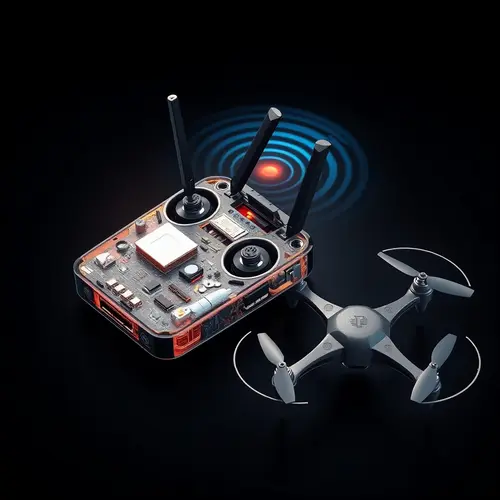
Understanding drone radio technology is fundamental to operating unmanned aircraft safely and effectively. A drone radio system consists of a transmitter (controller) and receiver (mounted on the aircraft) that communicate via radio frequencies to control flight operations, camera gimbals, and other onboard systems.
The communication between your controller and aircraft happens through sophisticated radio protocols. Most consumer drones operate on 2.4 GHz or 5.8 GHz frequency bands, though professional systems may use different frequencies depending on regulatory approval and operational requirements.
How Drone Radio Control Systems Function
Radio control systems translate pilot inputs into digital signals transmitted wirelessly to the aircraft. The receiver decodes these signals and sends commands to the flight controller, which adjusts motor speeds and servo positions accordingly.
Modern systems use spread spectrum technology—either Frequency Hopping Spread Spectrum (FHSS) or Direct Sequence Spread Spectrum (DSSS). These protocols reduce interference and improve signal reliability by spreading transmissions across multiple frequencies.
Latency matters tremendously in drone radio systems. Professional racing drones require sub-10 millisecond latency, while aerial photography platforms can tolerate 20-50 milliseconds without compromising control precision.
Frequency Bands and Legal Considerations
The Federal Communications Commission regulates radio spectrum usage in the United States. Most recreational drones operate in unlicensed ISM (Industrial, Scientific, and Medical) bands, but pilots must understand power output limitations and frequency restrictions.
| Frequency Band | Typical Range | Interference Level | Best Use Case |
|---|---|---|---|
| 2.4 GHz | 1-4 km | High (WiFi, Bluetooth) | General consumer drones |
| 5.8 GHz | 0.5-2 km | Moderate | FPV racing, short-range |
| 900 MHz | 10+ km | Low | Long-range professional |
| 433 MHz | 15+ km | Very Low | Extended telemetry |
Understanding Drone Radio Range Limitations
Advertised range specifications rarely reflect real-world performance. Urban environments with concrete buildings, electromagnetic interference from power lines, and atmospheric conditions all degrade radio signal strength.
Line-of-sight remains critical. Physical obstructions block or reflect radio waves, creating dead zones where control signals cannot penetrate. Smart pilots always maintain visual or telemetry awareness of signal strength indicators.
According to guidance from aviation safety organizations, pilots should establish failsafe protocols that activate when radio signal is lost. These typically include automatic return-to-home functions or controlled landing procedures.
Radio Control Channels and Their Functions
A drone radio transmits data across multiple channels simultaneously. Basic flight requires four channels: throttle, yaw, pitch, and roll. Additional channels control camera gimbals, lights, payload releases, and flight mode switches.
Entry-level systems offer 4-6 channels, while professional transmitters provide 12-16 channels or more. Each channel carries a discrete control signal, transmitted as a pulse-width modulation (PWM) or digital packet.
- Channel 1 (Aileron): Controls roll axis movement
- Channel 2 (Elevator): Manages pitch axis tilting
- Channel 3 (Throttle): Regulates motor power and altitude
- Channel 4 (Rudder): Adjusts yaw rotation
- Channels 5-8: Auxiliary functions like flight modes and camera control
- Channels 9+: Advanced telemetry, retractable landing gear, specialized payloads
Digital vs Analog Drone Radio Protocols
Legacy analog systems use PPM (Pulse Position Modulation) encoding, which is simple but susceptible to interference and offers limited data throughput. Digital protocols like MAVLink, CRSF, and SBUS provide bidirectional telemetry, encryption, and error correction.
Telemetry allows the aircraft to transmit battery voltage, GPS coordinates, altitude, and system warnings back to the pilot. This bidirectional communication transforms basic radio control into a comprehensive data link.
Popular digital protocols include Spektrum DSMX, FrSky ACCST, FlySky AFHDS, and TBS Crossfire. Each offers different trade-offs between range, latency, and compatibility with flight controllers.
Common Radio Interference Issues and Solutions
WiFi networks operate on the same 2.4 GHz band used by many consumer drones, creating potential conflicts. When multiple WiFi access points saturate all available channels, drone radio signals may experience packet loss or complete signal dropout.
Professional operators conduct RF spectrum analysis before flights in congested areas. Handheld spectrum analyzers identify which frequency channels have the least interference, allowing pilots to manually select cleaner bands.
Microwave ovens, power inverters, and poorly shielded electronics generate broadband noise that disrupts radio signals. Maintaining distance from known interference sources improves reliability significantly.
Expert Insight: The Myth of “Stronger is Better”
Many pilots incorrectly believe that maximizing transmitter power output always improves performance. However, excessive power can actually create problems.
Higher power output generates more electromagnetic interference affecting nearby electronics. In multi-aircraft operations, overpowered transmitters can overwhelm receivers on adjacent frequencies through harmonic distortion.
Regulatory bodies limit transmitter power for good reason. Properly designed drone radio systems achieve reliable range through efficient antenna design, error correction algorithms, and spread spectrum techniques—not brute force power.
Antenna Configuration and Placement
Antenna orientation dramatically affects signal quality. Linear antennas (straight wire types) transmit and receive best when parallel to each other. Circular polarized antennas offer omnidirectional coverage but at reduced maximum range.
Mounting antennas perpendicular to the aircraft body minimizes signal nulls. Carbon fiber components block radio frequencies, so antennas must be positioned away from structural elements or use antenna relocation extensions.
Diversity receiver systems use multiple antennas with different orientations, automatically selecting the antenna with the strongest signal. This redundancy prevents signal loss during maneuvers when the aircraft attitude changes.
Future-Proofing Your Drone Radio Setup
Modular radio systems allow firmware updates that add new protocols and features without hardware replacement. Open-source platforms like OpenTX and EdgeTX provide extensive customization options for advanced pilots.
Investing in receivers with built-in telemetry capabilities ensures compatibility with future flight controller features. Redundant receiver installations—using two separate receivers connected to different flight controller ports—provide critical backup for professional operations.
Understanding drone radio fundamentals empowers pilots to troubleshoot connectivity issues, optimize performance for specific environments, and make informed equipment decisions. Mastery of these systems separates competent operators from those who simply push sticks and hope for the best.

I'm Arjun, a Bali-based wedding organizer with over 5 years of experience in beach parties, live music, bridal makeup and catering. I share practical destination-wedding guides from real events. I have published 2,425 wedding guides here since 2022.



More Stories
Drone Water Shots: 7 Stunning Wedding Techniques
Ultimate Guide to Drone Events Planning
Pure Enchantment: Romantic Wedding Dresses That Capture the Heart Instantly